Most recently, my work considers Andean 'political geologies' past and present. This project has two frames: 1) it queries and critiques archaeological practice as a political geology project—one that understands geomaterials (e.g., clays, rocks) using Eurocolonial lenses and negates non-Western historical narratives; and 2) it examines the ontology of geomaterials in the past by considering how they are active participants within relational Andean worlds.
My writing on political geology was recently published in American Anthropologist.
In October 2024, I hosted the Wenner-Gren funded workshop, "Political Geologies Past and Present: Ontology, Knowledge, and Affect", at the Stanford Archaeology Center, alongside my co-organizer Andrew P. Roddick. This workshop brought together archaeologists that study ancient and recent pasts to consider the salience of political geology thinking in archaeological practice. Participants unsettled how archaeologists grapple with geo-materiality, landscape, and human/non-human relations so that we can write more inclusive archaeological narratives. A special issue that includes papers from this workshop is forthcoming in the Cambridge Archaeological Journal in 2026.
Since 2014, I have studied archaeological ceramics using elemental methods: laser ablation inductively coupled plasma mass spectrometry (LA-ICP-MS) and portable X-Ray Fluorescence Spectrometry (p-XRF). My primary interest is understanding clay pastes, which are the materialization of the recipes and geological landscape knowledge that potters use to craft their wares. Characterizing the geochemical "signature" of clay pastes allows me to trace this landscape knowledge and the sociopolitical relationships of the people who made and used ceramics in the archaeological past.
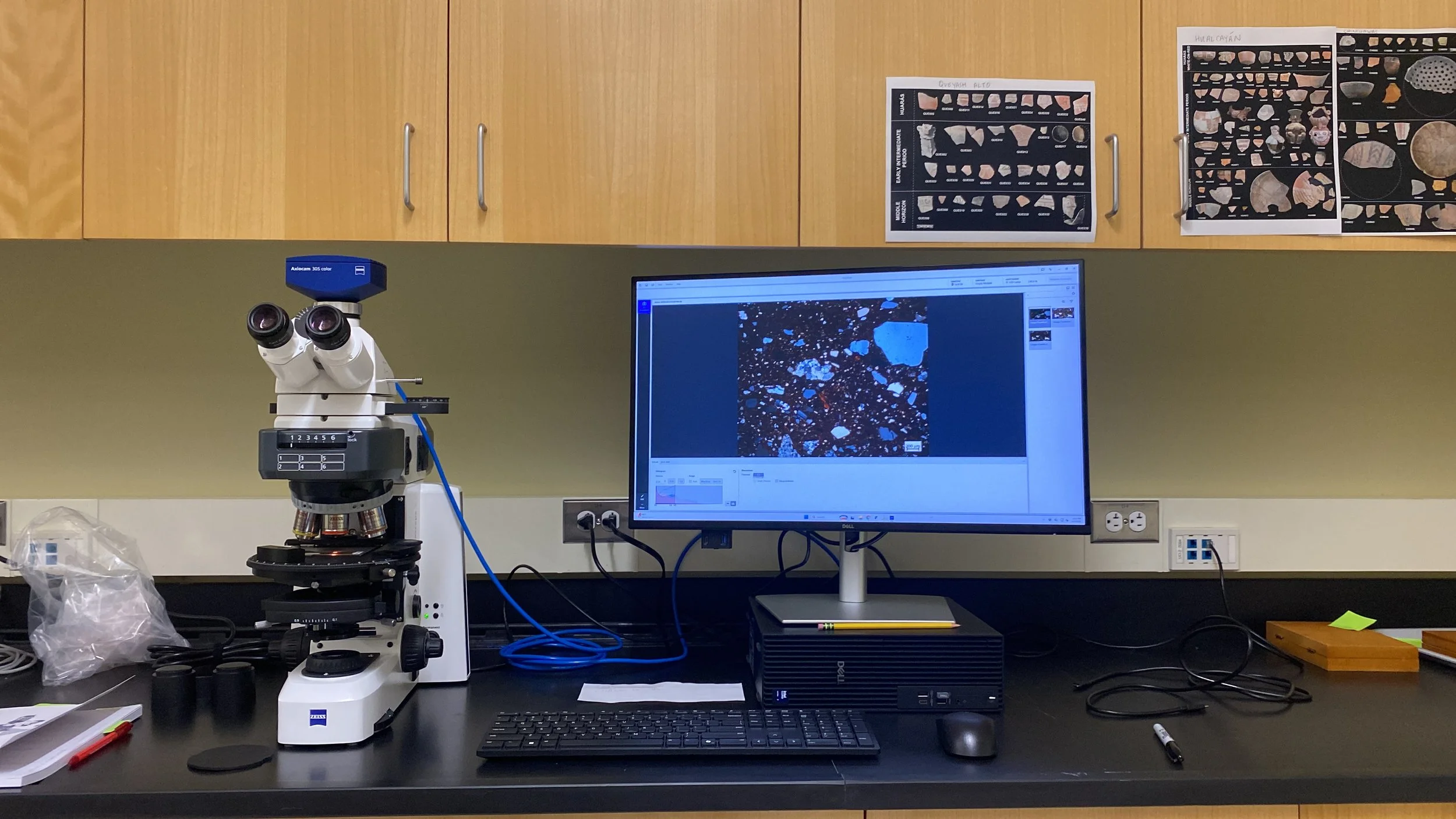
In 2017, I added thin section petrography to my methodological toolkit, which focuses on characterizing the mineralogy of clay pastes. Together, geochemistry and mineralogy provide invaluable information about intergenerational knowledge transmission, engagements with environmental landscapes, and the sociopolitical dynamics that undergird these processes.
I began my career in archaeology with a passion for textiles. As an avid knitter, sewist, and quilter myself, I maintain an active interest in fabric studies, past and present, more broadly.
Between 2011-2014, I served as the Textiles and Perishables Specialist for the Ancash Regional Archaeology Research Project (Proyecto de Investigación Arqueológico Regional de Ancash; www.piaraperu.org). In this role, I cleaned, catalogued, and photographed over 1,500 textile, cordage, and other perishable objects that were excavated from the highland archaeological site of Hualcayán between 2011-2013. I also led workshops to teach Peruvian and American undergraduate students about textile analysis and weaving.
My Master's Thesis examined the technological attributes of textiles, baskets, and cordage from Hualcayán's mortuary contexts. Finding textiles in the Andean sierra is rare due to its moist environment. My goal was to understand the techniques for spinning and plying fibers, weaving and basket making practices, as well as to identify the materials (cotton, vegetal, camelid) artisans used as a lens on community formation and social identity. Surprisingly, this work revealed a high proportion of cotton textiles—showing great variability in spin and ply of yarns—and a lower proportion of camelid (llama/alpaca hair) materials, all of which are more uniform in technique.
2021 Grávalos, M. Elizabeth, and Rebecca E. Bria. “Prehispanic Highland Textile Technologies: A View from the First Millennium AD at Hualcayán, Ancash, Peru.” Latin American Antiquity. Cambridge University Press, 1–19. doi:10.1017/laq.2021.30.
2014. Grávalos, M. Elizabeth. “Conceptualizing Community Identity through Ancient Textiles: Technology and the Uniformity of Practice at Hualcayán, Peru.” Master’s thesis, Lafayette, IN: Purdue University.
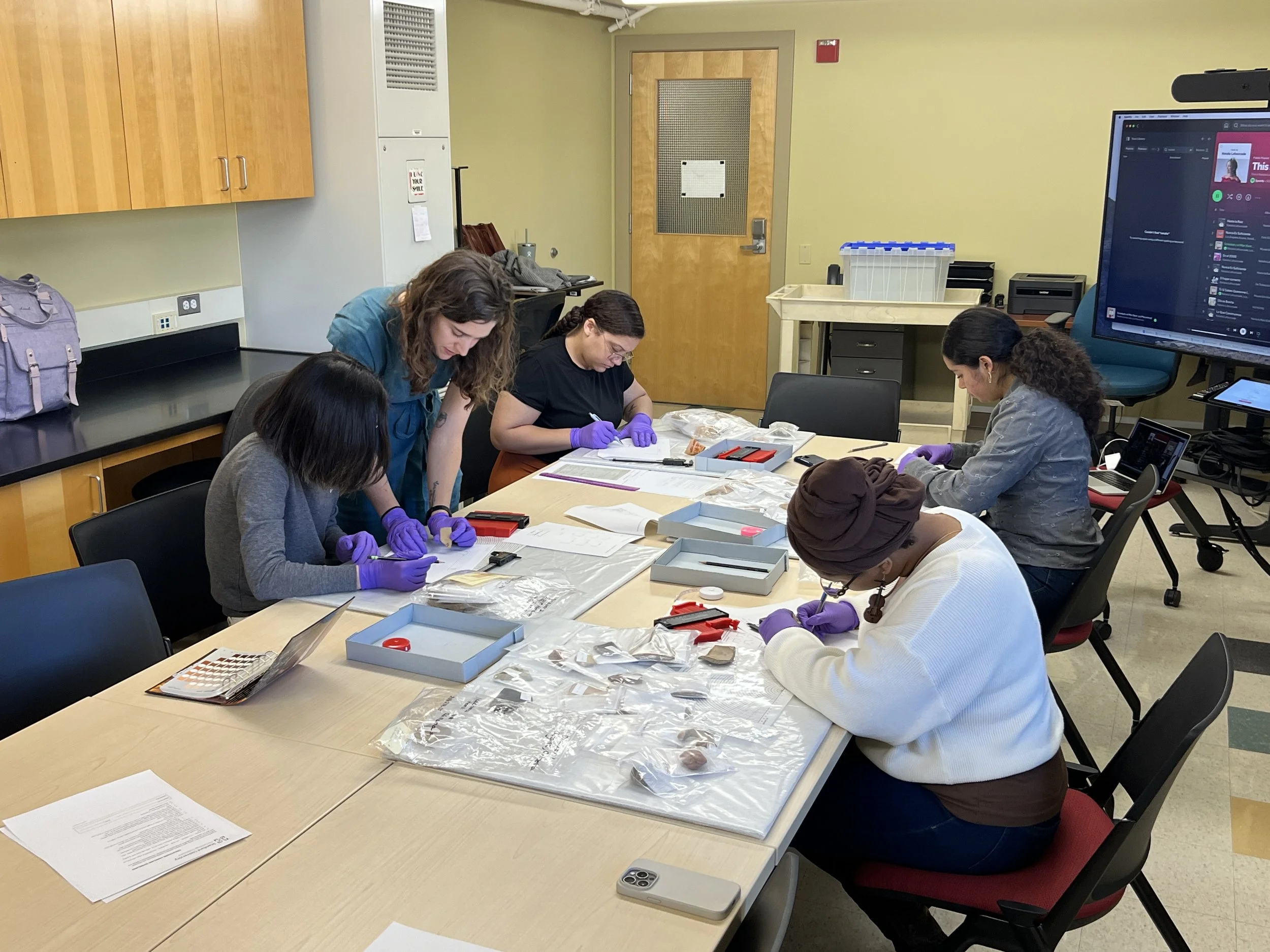
The Ceramic Research and Fiber Technologies (CRaFT) Lab is a space where researchers come together to examine social and political life in the past through the study of archaeological ceramics, geomaterials (e.g., rock, soils, clays), and perishables (e.g., textiles, cordage). We are concerned with understanding how making things is a political process that creates, maintains, and disrupts worlds.
Lab members share a commitment to community-based participatory research, in which research problems and outcomes are co-created with stakeholder communities. By working closely with descendant communities, our archaeological research is committed to crafting equitable futures.
Lab members utilize a variety of archaeological science techniques, including microscopy, elemental/molecular analyses (mass spec, XRD, Raman), and isotopes. Our lab houses 8 polarizing light microscopes for research and teaching, including a Zeiss Axioscope 5. Current projects focus on archaeological materials from Peru, including: thin section petrography of ceramics, molecular and elemental analyses of ceramic paints (Raman spectroscopy and XRD), soil micromorphology of a pre-Hispanic reservoir, and chemical analysis of textile dyes (LC-MS/MS).
The CRaFT Lab was established at the Stanford Archaeology Center in 2026 and is directed by Dr. Marie Elizabeth Grávalos.
Current Lab Members:
Daniela Fuenmayor, PhD Student, Stanford Anthropology
Collaborating with descendant communities to design research objectives and tangible outcomes has been a critical aspect of my archaeological practice in Peru since 2009.
Currently, I am a Co-PI for PIARA, the long-term community-collaborative research program within the province of Huaylas (Ancash, Peru). PIARA emphasizes descendant community wants and needs in its research, and organizes educational and medical support for Hualcayán and surrounding communities in Huaylas. As a PIARA project member since 2011, I have taught Peruvian and international undergraduate students, organized and led community workshops and programming, and directed and carried out specialized ceramic and textile analyses.
Between 2017-2018, I co-directed archaeological research at the site of Jecosh alongside colleagues Dr. Emily Sharp and Lic. Denisse Herrera Rondan (Proyecto de Investigación Arqueológica de Jecosh [PIAJ] or Jecosh Archaeological Research Project). In collaboration with the descendant community of Poccrac/Jecosh as well as Peruvian undergraduate students, we carried out site mapping, excavations, and artifact analysis. Our goal was to understand Jecosh’s role in the regional political economy during the rise of Recuay polities and the subsequent expansion of the southern Wari state (ca. 1-1000 CE) through the lens of domestic and mortuary contexts. Following conversations with Poccrac/Jecosh community members about how to turn work at Jecosh into a community resource, we co-curated a temporary museum exhibit (see museum work) to share our findings with the broader public in 2018. More info about our project is here: https://www.facebook.com/PIAJecosh
As PIAJ's co-PI, I secured research funds via grants (NSF, Wenner-Gren); co-designed project objectives and methods; organized community-collaborations; led excavations of household contexts; directed lab analysis of ceramics, lithics, soils, and animal bones; taught students about excavation techniques and lab analysis; and interpreted and wrote up research findings.
I have experience conducting research and overseeing public engagement at US and Peruvian museums. As someone who loves visiting museums and has worked behind the scenes, I believe that it is imperative to talk about the colonial history of Museums and hold active dialogue with stakeholders about social justice, collections care, object interpretations, and repatriation.
Between 2015-2022, I worked as a graduate and postdoctoral research associate at the Field Museum in Chicago, USA. During this time, I enjoyed engaging with visitors of all ages about the scientific research I carried out. Connecting Chicagoans to collections was a critical aspect of my time there, and included working in the Field Museum’s public oriented "Science Hub" and leading student groups on behind-the-scenes tours.
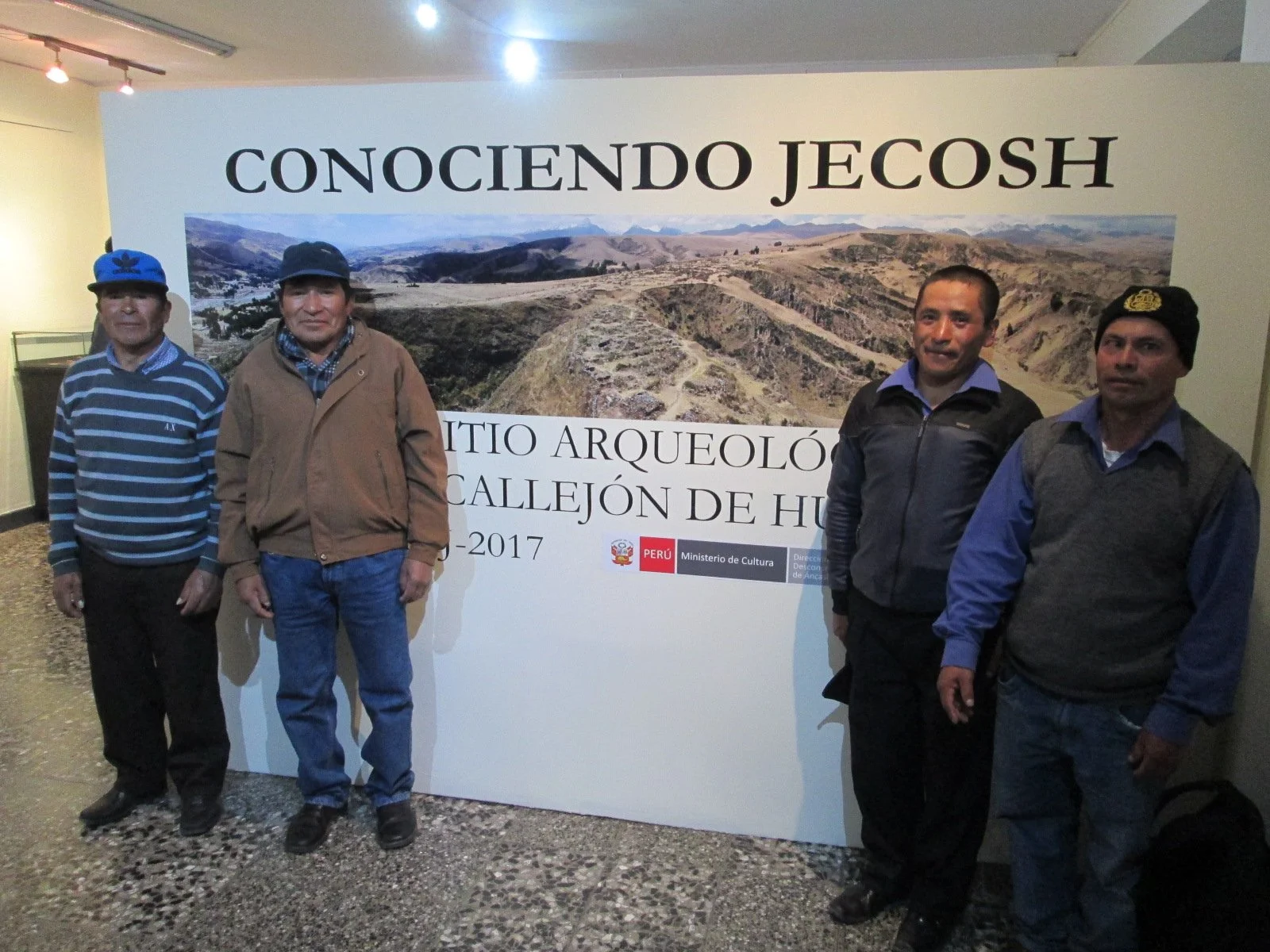
During my graduate work, I also conducted collections-based research at the American Museum of Natural History in NYC as well as the Museo Arqueológico de Ancash (Ancash Archaeology Museum) in Huaraz, Peru. Recently, as a part of the Proyecto de Investigación Arqueológica de Jecosh (PIAJ), my team and I co-curated a temporary museum exhibit at the Museo Arqueológico de Ancash with the descendant community of Poccrac/Jecosh. Held between July 6-August 26, 2018, Conociendo Jecosh: Un sitio arqueológico en el Callejón de Huaylas shared our research findings with the broader public.
I am committed to anticolonial, antiracist, and feminist pedagogical approaches. I love doing hands-on instruction—in addition to the classroom, I’ve taught in excavation, lab, and museum settings. I also have experience mentoring students and interns one-on-one at the Field Museum.
Teaching Experience
Instructor of Record
Stanford University:
-Making, Knowing, Resisting: Anthropology of Craft (undergrad/grad)
-Theory & Method in Ceramic Analysis (undergrad/grad)
-Archaeological Methods (undergrad)
-Archaeological Methods (grad)
-Proposal Writing for Archaeologists (grad)
University of Illinois-Chicago:
-Feminist Archaeologies (undergrad)
DePaul University:
-Introduction to Archaeology (undergrad)
Graduate Teaching Assistant (led lab and discussion sections)
UIC:
-Human Adventure
-Introduction to Biological Anthropology
-Economic Geography
-Introduction to Archaeology
Purdue University:
-Introduction to Archaeology & World Prehistory
-Human Cultural Diversity
-Introduction to Biological Anthropology
-Introduction to Anthropology
Fieldwork Instruction
Project Director and Field/Lab Instructor, Proyecto de Investigación Arqueológico de Jecosh (2017-2018)
Assistant Field School Instructor, PIARA Archaeological Field School, annual summer field seasons at Hualcayán, Peru (six student sessions between 2011-2013)
Teaching Assistant, DePaul Archaeological Field School, Chicago, IL (2010)